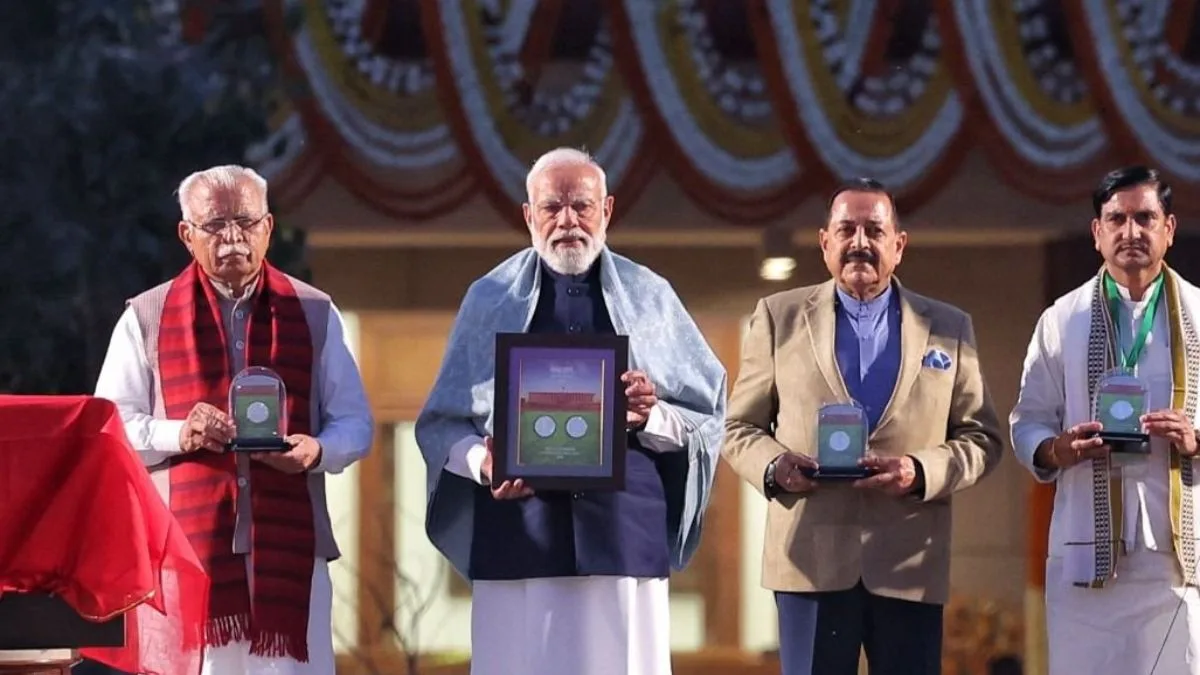
Asserting that India is decisively moving away from its colonial past, Prime Minister Narendra Modi on Friday dedicated Seva Teerth—the new Prime Minister’s Office—to the nation, describing it as a defining step in the country’s march towards becoming a developed nation by 2047.
Addressing a public gathering at the newly inaugurated complex, Modi said Seva Teerth, along with Kartavya Bhavan 1 and 2, marks “an important milestone in India’s journey towards Viksit Bharat” and reflects the government’s commitment to citizen-centric governance and national progress.
Advertisement
Declaring that the country is “removing symbols of colonial legacy,” the Prime Minister stressed that the transformation goes beyond symbolism. “It is not only about changing names but also about changing our approach to governance,” he said, adding that India must shed “every trace of colonial mindset” as it approaches 100 years of Independence.
From ‘Race Course Road’ to ‘Lok Kalyan Marg’
Modi cited the renaming of Race Course Road to Lok Kalyan Marg as emblematic of this shift in outlook. “This was not merely a change of name. It was an effort to transform the mindset of power into a spirit of service,” he said.
Calling it “unfortunate” that key roads near constitutional offices once bore colonial-era names, he remarked, “The road along the Prime Minister’s residence was called Race Course Road, and the one leading to the President’s House was Rajpath. In this journey towards Viksit Bharat, it is necessary to shed the colonial mindset.”
He emphasised that Seva Teerth and the Kartavya Bhavans have been constructed “to fulfil the aspirations of the people of India, not of any monarch.”
“I can say with pride that Seva Teerth and Kartavya Bhavans are built to fulfil the aspirations of Indians, not of any monarch,” he said, contrasting the new infrastructure with administrative symbols inherited from colonial rule.
Describing the new PMO as more than a physical structure, Modi said the name Seva Teerth captures the essence of India’s civilizational values.
“Seva, or the spirit of service, is the soul of India. It is India’s identity,” he said. “For us, governance means service, and service is the highest dharma.”
Earlier in the day, while dedicating Seva Teerth to the nation, the Prime Minister reaffirmed his “unwavering resolve” to public service and invoked the guiding ideal of ‘Nagrik Devo Bhava’—the principle that citizens must be treated with the highest respect and priority.
He described the complex as “a radiant and powerful symbol of duty, compassion, and commitment to the principle of India First.”
Linking the new complex to the government’s long-term vision, Modi said decisions taken within its walls would shape India’s future. “Decisions taken in these new buildings will determine the course of our journey to emerge as a developed nation by 2047,” he said.
Urging officials and employees to adopt a spirit of accountability, he added, “While entering these buildings, every officer and employee must reflect on whether their work that day will make life easier for the people.”
“The dreams of citizens are our greatest assets; their aspirations should guide us,” he said, reiterating that public welfare must remain at the core of policymaking.
The inauguration of Seva Teerth and Kartavya Bhavans comes as part of a broader push by the Centre to reorient governance around efficiency, accountability, and service delivery, while symbolically distancing modern India from colonial-era nomenclature and architecture.
Expressing hope that the new PMO would inspire future generations, Modi said it should motivate people to walk the path of selfless service and tireless dedication to the well-being of every citizen.
As India advances towards its 2047 development goal, the Prime Minister framed Seva Teerth not merely as an administrative headquarters but as a statement of intent, signalling that the architecture of power must reflect the spirit of service, and that the vision of Viksit Bharat rests as much on transformed governance as on new infrastructure.